MM
How Communication Theory Works in the Field of Design
In the field of design, and particularly in jewelry design, communication theory allows us to move beyond understanding objects as purely functional or decorative artifacts. Design operates as a communicative system in which meaning is produced through symbols, forms, materials, and cultural references. From this perspective, a designed object functions as a message that is interpreted by different audiences depending on their social background, experience, and group affiliation. Communication theory helps explain how meaning does not reside solely in the object itself, but emerges through interaction between the object, its context, and the viewer. This approach is especially effective in jewelry design, where objects are worn on the body and become part of everyday interpersonal and social communication.
Among the theories discussed in the course, semiotic and phenomenological approaches are particularly relevant to jewelry design. Semiotics allows us to treat jewelry as a system of signs, where lines, proportions, materials, and surface treatments operate as signifiers that point to broader cultural ideas. In contrast, phenomenology emphasizes that meaning is co-created through embodied experience: touch, weight, proximity to the body, and personal associations. These approaches are effective in design fields where interpretation, emotion, and sensory perception play a central role. At the same time, purely informational or transmission-based models of communication are less applicable to jewelry design, as they assume a fixed meaning that is simply delivered from sender to receiver, leaving little room for interpretation or personal engagement.
Social theories of communication, such as Social Identity Theory and Symbolic Convergence Theory, further expand the understanding of how designed objects operate within groups. Jewelry often functions as a marker of belonging, signaling alignment with certain values, professions, or cultural communities. Through shared symbols and repeated use, objects contribute to the formation of group meanings and collective identities. Structuration Theory provides an additional framework by explaining how design both shapes and is shaped by social practices: jewelry reflects existing cultural structures while simultaneously enabling new forms of self-expression and interaction. In this way, communication theory demonstrates that in the field of design, effectiveness lies not in clarity alone, but in the capacity of an object to support interpretation, identity construction, and shared meaning over time.
Presentation for a General Audience
«Only Millimeters Left» — brand concept

Only Millimeters Left. Maria Fomina. Photo. 2025
«Only a Few Millimeters Left» is a jewelry brand inspired by architectural drawing language: dimension lines, measurement scales, construction marks, and metal plan fragments.
We approach jewelry as a form of visual communication rooted in professional culture — a material trace of thinking in structures, systems, and precision.
Our brand is designed for architects, engineers, designers, and for a broader audience attracted to minimalist, rational, and concept-driven aesthetics. The jewelry translates the invisible processes of design and calculation into wearable symbolic forms.
Visual Identity
Only Millimeters Left. Maria Fomina. Photo. 2025

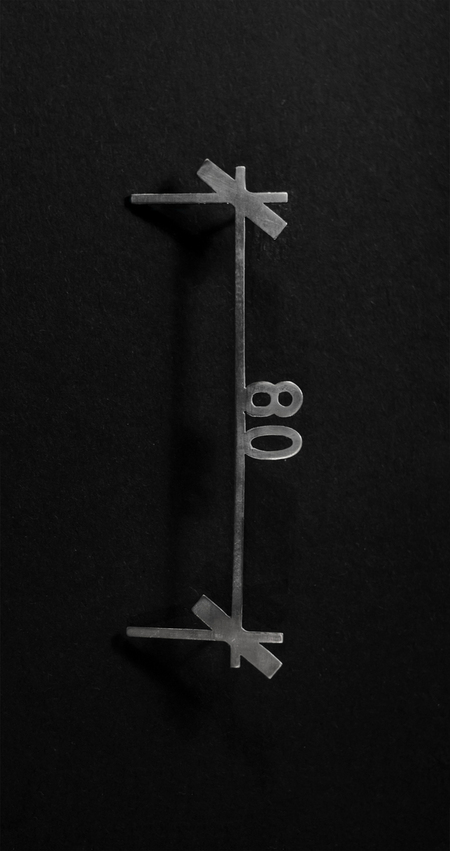
Only Millimeters Left. Maria Fomina. Sora AI. 2025 Only Millimeters Left. Maria Fomina. Photo. 2025
Semiotic perspective: jewelry as a sign system
From a semiotic perspective (Craig), each object functions as a complex sign composed of material, form, and cultural reference.
- Linear geometry refers to architectural drawing conventions and systems of measurement.
- Metallic surfaces symbolize durability, structure, and technical rationality.
- Minimalist composition rejects ornament in favor of clarity and legibility.
- The jewelry communicates the message that precision, restraint, and process are values worth carrying on the body. The object does not explain itself explicitly — it invites interpretation by those capable of «reading» the code.
Phenomenological approach: meaning through experience
Following the phenomenological tradition, we assume that meaning is co-created through lived experience and interaction with the object.
Wearing «Only Millimeters Left» jewelry becomes a bodily experience of scale, line, and proportion. The pieces do not imitate architecture directly; instead, they evoke the embodied memory of drawing, measuring, correcting, and refining.
Thus, jewelry becomes an invitation to dialogue — with one’s own professional identity, with the culture of design, and with others who recognize these symbols.
Narrative paradigm
The brand aligns with Walter Fisher’s narrative paradigm. «Only Millimeters Left» tells a story about process rather than result: about drafts, unfinished calculations, corrections, and the beauty of incompleteness.
The wearer projects this narrative onto themselves — as someone who values thinking, making, and refining over spectacle and excess.
Only Millimeters Left. Maria Fomina. Sora AI. 2025
For a general audience, the brand «Only Millimeters Left» communicates through familiar, everyday meanings rather than professional codes. For people without architectural or engineering training, measurement lines and dimension marks from CAD drawings are perceived not as technical systems, but as simple segments — something similar to a ruler, a centimeter, or a measurable distance. In this context, the jewelry translates complex professional symbols into accessible and emotionally resonant forms.
These linear elements become metaphors rather than tools. A measured line turns into a symbol of a small remaining distance — a short stretch of time, effort, or space separating a person from a goal, a change, or a dream. «Only millimeters left» functions as a light, almost ironic statement: the idea that something important is close, not abstract or unreachable, but nearly within touch. This playful interpretation introduces humor and warmth into an otherwise strict visual language.
At the same time, the jewelry maintains a minimalist aesthetic that appeals to design-oriented audiences. Clean lines, reduced forms, and restrained materials allow the pieces to function as everyday accessories without requiring specialized knowledge to be understood. Meaning is created phenomenologically, through personal interpretation and lived experience: the wearer assigns their own «distance, ” their own remaining millimeters, whether emotional, temporal, or aspirational.
In this way, communication with the general audience follows the principles outlined in the course: meaning is not fixed within the object itself, but emerges through interaction, cultural context, and individual interpretation. The jewelry becomes a quiet communicative gesture — both a minimalist design object and a symbolic reminder that something meaningful is very close.
Only Millimeters Left. Maria Fomina. Photo. 2025
Target audience and key message
- People interested in minimalist and conceptual design - Urban audience (20–40 years old) - Individuals who value subtle symbolism and quiet humor in objects - Non-professionals who are drawn to architectural aesthetics without technical knowledge
Key message
«Only a small measure left.» Something simple you can measure, remember, or laugh about.
Communication goal
To transform abstract architectural symbols into emotionally accessible metaphors, allowing everyday users to interpret the jewelry as both a minimalist design object and a personal symbol of anticipation, progress, and playful self-reflection.
Presentation for a Professional Audience
Only Millimeters Left. Maria Fomina. Sora AI. 2025
For the professional audience — architects, engineers, designers — Only Millimeters Left operates through a different communicative layer. Measurement strokes, dimension lines, and plan fragments are not abstract symbols here, but deeply familiar professional signs. They reference the everyday visual language of drawings, layouts, and technical documentation — a language shared within the professional group.
In this context, the jewelry functions as an in-group symbol. It externalizes professional identity and makes it visible outside the workspace. The measurement line no longer signifies a generic distance, but the discipline of precision, responsibility, and decision-making. A few millimeters can define success or failure, feasibility or error. The brand name becomes a professional statement: progress, deadlines, and solutions are always measured, calculated, and negotiated.
The objects communicate respect for the process rather than the final result. They reference work-in-progress, unfinished plans, and the constant state of refinement that defines architectural and engineering practice. Wearing these objects allows professionals to carry their professional worldview into everyday life, reinforcing social identity and recognition within their reference group.
Target audience
Architects, engineers, designers, and students of technical and design disciplines who share a common visual language of plans, measurements, and construction logic.
Key message
«Precision as identity.»
Communication goal
To reinforce professional social identity through symbolic objects that translate technical visual language into wearable form, strengthening group belonging and non-verbal recognition within the professional community.
Communication Theory as the Basis of the Project
Symbolic Convergence Theory
Symbolic Convergence Theory helped us understand how shared symbols can create a sense of group belonging. In our project, the measuring line and dimension marks function as a dramatizing symbol.
For the general audience, these elements evoke simple, shared associations: a segment, a unit of measurement, a short distance — something small and relatable. The idea of «only a few millimeters left» works as a light metaphor and even a visual joke, creating emotional resonance and shared meaning.
For the professional audience, the same symbols trigger collective memories of architectural practice, drawings, deadlines, and precision. This shared professional imagery supports symbolic convergence within the architectural and design community, forming a recognizable in-group code.
Social Identity Theory
Social Identity Theory explains how people define themselves through group membership.
For the general audience, wearing our jewelry allows individuals to affiliate themselves with a cultural group that values minimalism, design thinking, and conceptual aesthetics. Even without professional expertise, the wearer symbolically aligns with the identity of a «design-aware» person.
For the professional audience, the jewelry directly reinforces professional identity. Dimension lines and drafting symbols operate as markers of in-group belonging, making professional identity visible in everyday life and strengthening the sense of «we» among architects, engineers, and designers.
Structuration Theory
Structuration Theory helped us frame jewelry as both a product of social practices and a structure that shapes them.
The measuring line is a familiar structure: it sets limits, defines scale, and organizes thinking. By transferring it into jewelry, we allow users to reproduce this structure in a new context — daily life and personal expression.
Professionals reproduce their habitual ways of thinking about space and precision, while non-professionals reinterpret the structure more freely — as time, distance, or a metaphorical «last step.» Thus, meaning is continuously recreated through use.
Functional Theory of Group Decision Making
Functional Theory informed our design and communication decisions by focusing on clarity of purpose.
We identified a clear problem: how to communicate architectural thinking to different audiences without overloading meaning. The solution was to create a single visual system that functions on multiple levels.
For the general audience, communication prioritizes emotional clarity and accessibility. For the professional audience, it prioritizes conceptual accuracy and symbolic depth. This ensures that our communication fulfills its function for both groups without conflict.
Sources
Communication Theory: Bridging Academia and Practice. Course materials. Accessed: 5 December 2025.
Craig R. T. Communication Theory as a Field // Communication Theory. 1999. Vol. 9. No. 2. P. 119–161. Accessed: 11 December 2025.
Fisher W. R. Human Communication as Narration: Toward a Philosophy of Reason, Value, and Action. Columbia: University of South Carolina Press, 1987. Accessed: 12 December 2025.
Tajfel H., Turner J. C. The Social Identity Theory of Intergroup Behavior // Psychology of Intergroup Relations. Chicago: Nelson-Hall, 1986. P. 7–24. Accessed: 12 December 2025.
Merleau-Ponty M. Phenomenology of Perception. London: Routledge, 2012 (orig. 1945). Accessed: 12 December 2025.
Krippendorff K. The Semantic Turn: A New Foundation for Design. Boca Raton: CRC Press, 2006. Accessed: 13 December 2025.
1.Maria Fomina. Educational project «Only Millimeters Left [Electronic resource]. — Available at:https://hsedesign.ru/project/2342f636587a44d58204962d43e4cc31 Accessed: 10 December 2025.