Сontent
- Communication theory in the field of design
- Presentation of the Vegan’s eco brand for a general audience
- Presentation of the Vegan’s eco brand for a professional audience
- Communication theory in the field of design
- List of literature and sources of images
Communication theory in the field of design
Design is not only how something looks — it is how a message is structured, made visible, and made believable. Every decision (color, rhythm, typography, image choice, material metaphor) encodes an idea about what a brand is, who it is for, and how it wants to be treated.
Classic communication models describe a clean pipeline: a sender encodes a message, transmits it through a channel, and a receiver decodes it. In design terms, this suggests a neat path from intention («we are eco-friendly») to perception («I understand and trust that»). But brand communication almost never behaves like a straight wire. Meaning does not travel unchanged. It bends through culture, habits, and attention. It is edited by context.
The Emmert–Donaghy framework is useful here because it treats communication as inseparable from the environment: physical, cultural, social, and technological. For a restaurant identity, context is not decoration — it is a meaning engine.
The same green logo reads differently on a street sign, on a delivery app tile, inside a calm interior, or on a chaotic social feed. In one context, green can signal «healthy and fresh»; in another, it can signal «moral pressure» or «lifestyle marketing.» The designer’s task is to anticipate these shifts and build cues that keep the meaning stable enough to be recognized, but open enough to be welcomed.
James N. Craig proposed a systematization of theoretical approaches to communication, identifying seven traditions. Their goal is to describe how people create, transmit, and interpret meaning in different contexts. These traditions do not compete in essence; each provides a unique perspective on the communication process and its impact on individuals and society.
Craig’s 7 traditions of communication theory
• cybernetic • socio-psychological • socio-cultural • critical • rhetorical • phenomenological • semiotic

Semiotics deepens this view. It frames every design element as a sign: not a neutral form, but a carrier of cultural associations. Organic lines, hand-drawn textures, leaf shapes, and «fresh» color palettes do more than decorate; they perform values such as care, softness, and non-violence. Yet signs do not have fixed meanings. A sign becomes meaningful through interpretation — and interpretation depends on audience experience, ideology, memory, and learned visual language.
Communication theory reframes design as shared meaning-making: the brand proposes a meaning; the audience completes it.
Modern communication theory also emphasizes feedback. Communication is not one-directional; it is interactive. Contemporary brands exist in a loop: people comment, recommend, remix, criticize, screenshot, and translate. The brand identity becomes a living system rather than a finished artifact. For Vegan’s eco, this matters because «ethical food» can easily become polarizing online. The design must therefore build a tone that invites dialogue rather than confrontation — a calm, friendly language that reduces defensiveness.
Presentation of the Vegan’s eco brand for a general audience
What can be more urgent than food? Vegan’s eco is a fictional vegan raw-food restaurant — a place where people can feel good without having to «perform» correctness.
Vegan’s eco specializes in vegan and raw cuisine. But the main feature is not «ingredients» — it is an atmosphere: friendly, safe, non-judgmental. The restaurant carries the idea that animals are friends, and that care can be expressed through simple choices: vegetables, fruits, nuts, seasonal products, and transparent preparation.
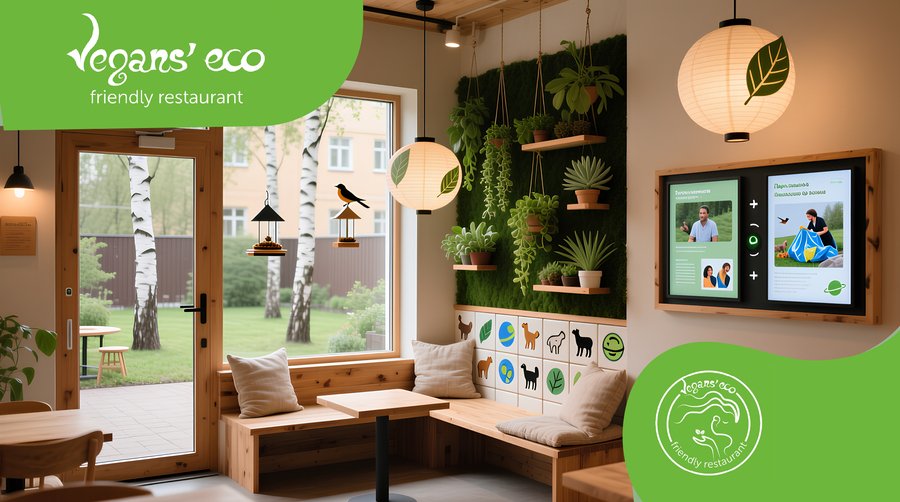
«Feel good here.» Wide-audience hero image should communicate comfort first, ethics second: light, space, calm, friendliness. The message is hospitality, not ideology

What you can expect
- fresh raw and plant-based meals that feel light but satisfying;
- a friendly staff tone: supportive, not instructive;
- a calm environment for meeting friends, studying, or decompressing;
- a sense of care for nature expressed through details (waste reduction, thoughtful packaging, charity actions).

Who is it for
Vegan’s eco targets young adults (18–25) in Saint Petersburg with moderate income and varied occupations. They are interested in charity, domestic and wild animals, and everyday eco-actions. They want wellbeing «for all living beings» and worry about the planet’s future — but they also want a place that feels emotionally safe.
Core message:
Vegan’s eco is a place where nature speaks with a person — quietly, warmly, and safely.
Presentation of the Vegan’s eco brand for a professional audience

Brand platform
Vegan’s eco is positioned as a «friendly restaurant» built on safety, calmness, and ecological responsibility. It communicates ethical eating without confrontation, and frames vegan raw food as an everyday pleasure.
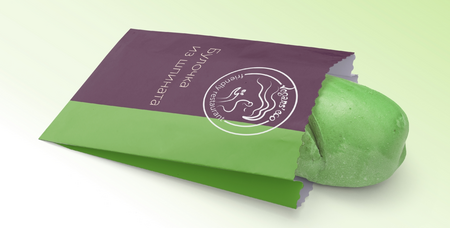
Brand personality
Calm, comfortable, bright, friendly, joyful, ecological, vivid, alive, green, mindful, positive, peaceful, clean, fresh, healthy, charitable.
Personality system: moving away from «activist loudness» and toward «welcoming calm.» This reduces resistance and supports long-term loyalty.

Functional and emotional benefits
Functional: raw and plant-based cuisine, balanced eating, clear ingredients, seasonal logic.
Emotional: freshness, friendliness, safety, a quiet sense of belonging.
Competitive landscape (as references)
The following are reference points used for educational comparison (not claims about real businesses).Shambala: variety and presentation; weakness in «place to stay» (delivery-only perception).
Eat Fresh: youth-oriented, friendly staff; weakness in «satiety» (snacks/smoothies stereotype).
Ukrop: warm cafe with sweets; weakness in positioning limited to vegetarian framing.
Communication tone and channels
Tone: warm, non-judgmental, quietly optimistic. The brand avoids «purity language» and uses invitations: «try, ” „listen, ” „feel, ” „take care, ” „you are welcome.“
Main touchpoints: street signage, interior, menu, delivery app tiles, social media posts, community events. Key rule: never shame the audience; always protect autonomy and dignity.
Communication theory in creation and promotion of the brand
Semiotics: building a sign system
Vegan’s eco relies on a simple sign vocabulary that translates «care for nature» into everyday friendliness: leaf/sprout forms, organic curves, hand-made textures, and a soft «fresh» rhythm. In semiotic terms, these are repeated cues that stabilize interpretation across contexts. The identity does not depend on one logo alone; it creates a small language: shapes, line quality, spacing, and tone-of-voice.Visual research: hand-drawn metaphors that translate «nature speaks» into simple signs (leaf, fruit, organic shapes)