
Contents:
[1] Our Reasoning: How Communication Theory Works in the Field of Brand Identity Design [2] Presentation for a general audience [3] Presentation for a professional audience [4] How Communication Theory Served as the Basis for Creation [5] Bibliography and Image sources
[1] Author’s Reasoning: How Communication Theory Works in the Field of Brand Identity Design
We believe that in design practice, brand identity is not a collection of visual artifacts, but it functions as a structured, multi-layered communication system.
In that context communication theory provides a framework for understanding how this system produces meaning, organizes perception, and establishes relationships with audiences. From this perspective, identity design becomes a form of applied communication rather than purely visual styling.
Traditional design approaches often emphasize aesthetics or functional advantages. Communication theory shifts this focus toward meaning-making. The central question is no longer only what does it look like, but what does it communicate, to whom, and within which context. Every design element such as logo, color, typography, material choice etc, operates as a sign within a broader semiotic system.
Another advantage of using communication theory in design is the understanding of branding as a dialogic process with two-way interaction. Contemporary communication models emphasize interaction, feedback, and participation. Brand identity systems increasingly function as open frameworks that invite audiences to interpret, adapt, and complete meaning. These elements do not function in isolation; they acquire meaning through cultural associations, narrative and dialog.
The communication theory also studies the role of the medium itself. Communication does not occur independently of form, material, or channel. The choice of medium (physical or digital) carries its own message. Design decisions must therefore reinforce the core communicative intent of the brand identity. Materiality, format, and distribution become integral components of meaning, not neutral containers.
In this sense, communication theory acts as a strategic blueprint for branding. It prompts designers to articulate core communicative intentions, define audience contexts, encode values into symbolic systems, and construct identities capable of sustaining long-term relationships. Rather than treating branding as surface decoration, communication theory positions identity design as an ongoing process of meaning negotiation between organization, medium, and audience.
[2] Presentation for a General Audience
Hello, I am ICHI. I am more than a perfume. I am a feeling from the heart of Yakutia, captured for your everyday life. Let me explain to you what the North is.
Outdoor billboard: large-scale brand message in urban context
On the most basic level, what you see and feel: I am a solid perfume stick and vial in beautiful, refillable glass. My packaging is made from eco-friendly materials.



[1-3] Glass perfume bottles



Tactile shapes, wood
No spray, no alcohol, no clouds of scent. This simple, elegant form means I am gentle. I won’t irritate your skin or trigger allergies. I am made for touch and personal application. I am quiet, intimate, and entirely yours. The packaging is designed to be kept, refilled, and cherished, reducing waste.
On a practical level, what I do for you: I am a guardian of your well-being and expression. My core is made with nourishing oils and the pure essence of Yakutian plants: crisp pine, healthy grasses, ancient woods.
A series of vials
I give you a unique, natural scent that stays close to your skin, a personal signature. For those with sensitivities, asthma, or a desire for clean ingredients, I offer a safe way to wear fragrance. I am the reliable, caring choice for your daily ritual.
On the deepest level, how I make you feel: I am a source of calm and confident independence.
Product presentation
My scent and philosophy are designed to cut through the noise. I don’t shout for attention; I invite a moment of peace. Wearing me is an act of self-care—a reminder to embrace your own pace, to feel grounded, and to express yourself on your own terms, safely and mindfully. I am the scent of personal space, inner strength, and harmony with nature.
My promise to you: With ICHI, your aromatic trace will be memorable to others, but always kind. To your skin, your senses, and our planet.
[3] Presentation for a Professional Audience
Corporate identity: brandbook
Variable posters
Essence Mindful solidity — the convergence of northern purity, personal safety, and conscious self-expression.
Mission To make self-expression safe and mindful.
Promise A memorable aromatic presence that is harmless to people and nature.
Values Eco-consciousness, independence, health-oriented care.
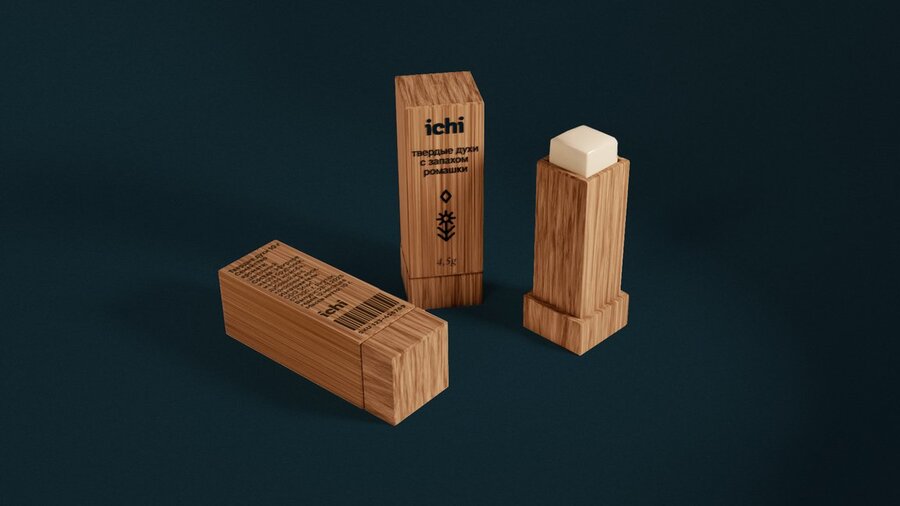
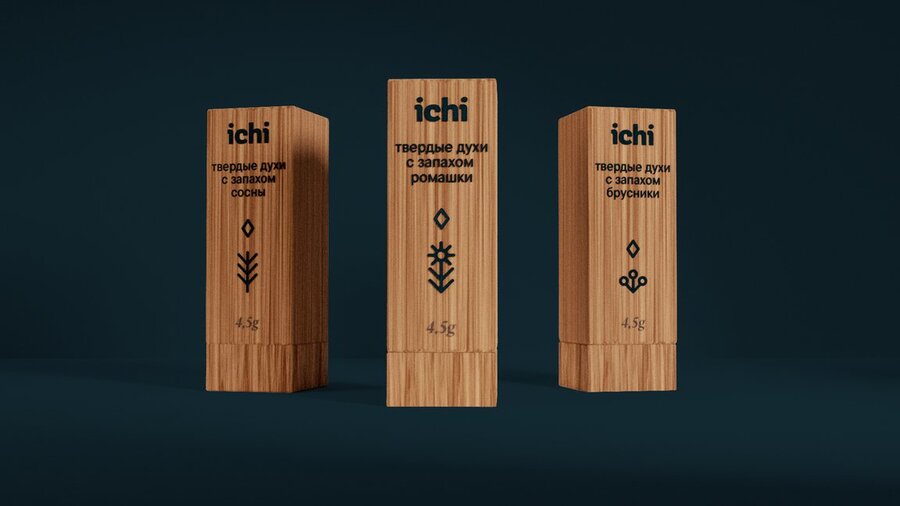
[1-2] Wooden packaging
Positioning The brand is positioned through strategic communication framing rather than simple category competition. Instead of being presented itself as a «natural perfume,» it is framed as a practice of mindful care. This approach connects geographic origin, bodily safety, and environmental responsibility into a single communicative concept, forming a clear, value-driven niche.
Audience The core audience consists of women aged 20–30 with above-average income and high cultural awareness. They value autonomy, seek refined sensory experiences, and consciously choose niche products aligned with ethical and health-related concerns. Their decisions are based on their intentions: it relies on alignment with personal values, social approval of mindfulness, and confidence that the product integrates seamlessly into their lifestyle. Communication therefore emphasizes value coherence and accessibility rather than persuasion through pressure.
In the general context communication applies to the following types of publics: aware public (but inactive, active public (working to solve their problem) and activist public (organized and collective action).


[1] Shopper; [2] Clothes
Verbal Strategy The brand communicates as a knowledgeable and respectful companion rather than an authoritative seller. This establishes trust and lowers communicative distance, positioning the brand within a dialogic rather than directive framework.
Core Verbal Idea «The North is …» functions as an open-ended semantic structure. Instead of delivering a fixed message, it invites interpretation. This allows audiences to project their own meanings (for example calm, resilience, purity, or freedom) into the brand narrative, fostering shared symbolic understanding and long-term emotional engagement.
Tone of Voice Calm, confident, neutral, and kind. This tone deliberately contrasts with the aggressive and overstimulating language common in beauty marketing and advertising. Through consistency, the brand builds an alternative communicative environment associated with safety, clarity, and trust.
A series of posters with different meanings
Brand Roles as Communication Functions
To reduce complexity, the brand operates through three core communicative roles:
1. The intelligent friend The brand, being as a positive face, shares knowledge and meaning rather than instructions. Through flexible language and repeatable symbols, it builds a shared semiotic code with its audience. Communication is mutual: feedback and participation are encouraged, allowing the identity to evolve through dialogue rather than control.
2. The connecting medium The product itself functions as a medium. Materiality, scent, and tactile interaction communicate cultural and geographic meaning beyond language. In this sense, design is not a container for the message — it is the message. The brand becomes a bridge between distant nature and personal daily ritual, reinforcing its role in community and cultural connection.
3. The source of calm Within an overstimulated media environment, the brand deliberately cultivates quietness. Through restrained visuals, stable tone, and transparent communication, it becomes associated with psychological comfort. This role strengthens trust, supports reputation management, and enables constructive dialogue in moments of doubt or crisis.
Visual code as a system: color palette, pictograms, and landscape references
Visual Rhetoric & Design Logic
Design as Communication Visual identity is treated as a rhetorical system. Every element functions as a sign whose meaning emerges through context, repetition, and relationship to other elements.
Color System The turquoise spectrum operates on both physiological and symbolic levels. Cool tones are associated with calm and reduced nervous-system activation, while culturally referencing water, ice, air, and purity. Color thus functions as a non-verbal argument for safety and tranquility.
Pictogram System Abstract pictograms derived from northern flora and natural phenomena form a modular visual language rooted in Yakut ornamental traditions. Like the verbal system, these elements are variable and combinable. They function as a brand-owned symbolic code, enabling narrative continuity and meaning-making across media without reliance on text.

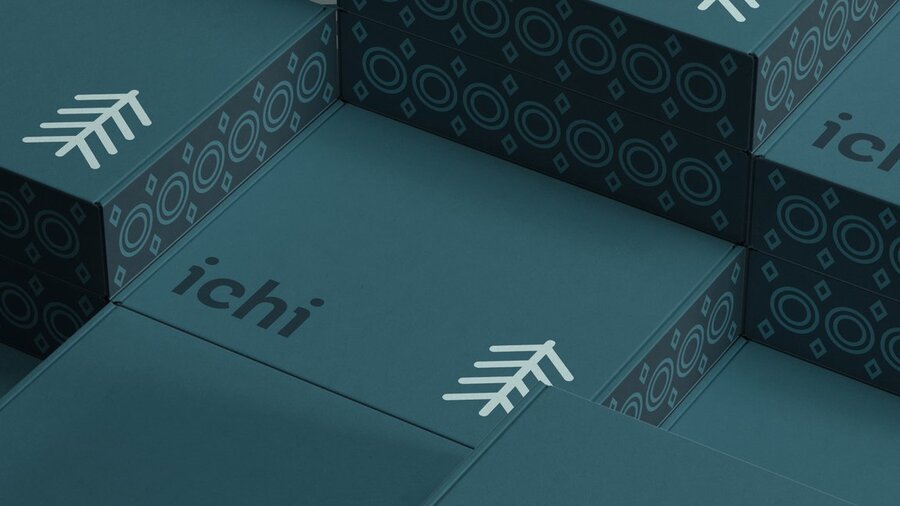

[1] Object: packaging; [2] Product; [3] Brand message and visual language in public space
Compact packaging
Shopping bags
Ribbon with pictographs: sign, repeat, semiotics
[4] Detailed Explanation: How Communication Theory Served as the Basis for Creation
The structure and content of all presentations were developed on the basis of the theoretical framework introduced in the course. We used PR-theory, narrative theory, social-media studies, semiotic theory types of public and others.
Foundational approaches to communication and semiotics establish design as a process of encoding and interpreting symbolic meaning rather than a purely aesthetic activity. Narrative and rhetorical theories further position brand identity as a form of structured storytelling and persuasion, where meaning emerges through sequence, repetition, and visual logic. Media-oriented theories contribute the understanding that the material form of a product and the medium through which it operates are integral components of the message itself.
The major part of communication productivity is an audience and two-way strategy of communication process. To formulate a portrait of core audience we used Ajzen’s Theory of Planned Behavior, which explains howpeople make desicions. Finally, dialogic models of communication and public relations shift the focus from one-directional transmission toward interaction, participation, and relationship-building. Together, these perspectives form the theoretical basis for treating brand identity as a dynamic communicative system.
Conclusion
The general audience presentation represents the final communicative output of the project. The professional presentation articulates the strategic and theoretical structure that enables this output. Our argumentation substantiates the need to use communication tools as the foundation for holistic, meaningful, and ethically responsible design.
Overall, the project exemplifies an iterative research process in which theoretical concepts are applied to a practical design case, generating outcomes that may contribute to further reflection on communication-driven approaches to brand identity design, while communication theory will help us at each stage.
[5] Bibliography and Image sources
Sourses of the text
When preparing the presentation, we relied on HSE Communication Theory online-course materials such as:
— Week 1, Lecture 1.5: Craig’s 7 Traditions (the Semiotic tradition) — Week 2, Lecture 2.2: Politeness Theory — Week 4, Lecture 4.3: Ajzen’s Theory of Planned Behavior — Week 4, Lecture 4.4: Fisher’s Narrative Paradigm — Week 4, Lecture 4.5. Digital Rhetoric — Week 5, Lecture 5.3: Media Ecology by McLuhan — Week 5, Lecture 5.5: Cultivation Theory — Week 7, Lecture 7.1: Public Relations — Week 7, Lecture 7.2: Four Models of PR, the two-way symmetrical model uses communication — Week 7, Lecture 7.6: Dialogic Theory
Project by Victoria Malko. Ichi packaging design. URL: https://hsedesign.ru/project/896d4feeecc14b51a15c5cf299446026
Project by Victoria Malko. Ichi identity design. URL: https://hsedesign.ru/project/dd621d91fb394e64a2c38b3225cfd323