План урока
◦научить студентов структурировано презентовать проект на английском ◦отработать лексику и фразы для питчинга ◦развить уверенность при публичном выступлении ◦научиться отвечать на вопросы аудитории

Hi everyone! Today we’re going to work on project pitching — a very important skill for designers.
Before we start, let’s talk a bit and activate our English.
Let’s start with a simple question.
What is a pitch? How would you explain it in your own words?
Who do designers pitch projects to? Clients? Employers? Investors? Team members?
Have you ever pitched an idea before? It can be in English or in your native language. It can be a project, a concept, or even an idea to a friend.
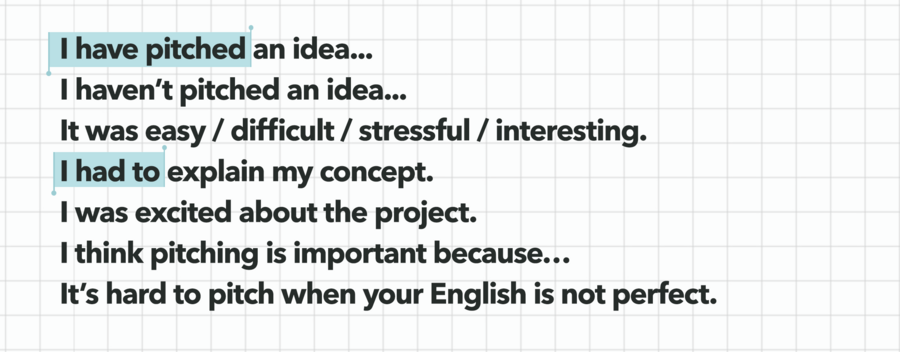
Great! So, a pitch is a short and clear presentation of an idea. Today, you’ll work in pairs, create a small project, and pitch it in English.
Don’t worry about mistakes — the goal is clear communication, not perfect English.
Let’s move on!

Now let’s work with the vocabulary for pitching.
Please don’t try to remember all the words. Choose 10 to 12 words that you think are useful for your project pitch.
First, let’s understand the words.
Take one word and try to explain it in your own words. You don’t need a perfect definition. After that, use the word in one simple sentence.
Now that we have talked about what a pitch is, let’s look at a simple structure for your project pitch.
A good pitch usually answers five questions. Let’s go through them.
You can follow this structure when you prepare your pitch in pairs.
Don’t worry about making it perfect. Focus on clarity and simple sentences.
Now it’s time to work in pairs and create your own project.
You don’t need a big or complicated idea. Keep it simple and clear.
In your pair, please do the following:
First, choose a project idea. It can be: ◦an app ◦a brand ◦a website ◦a service
Next, decide what problem your project solves.
Then, define who your project is for — your target audience.
After that, prepare a short pitch. Your pitch should be 2–3 minutes long.
Great job, everyone! You all did a really good job presenting your ideas.
Now let’s take a few minutes to reflect on the pitching experience.
Today you: ◦learned a simple pitch structure ◦practiced useful pitching phrases ◦created and presented a project in English
This is a very important skill for designers — and you’re already doing it.
Next time, we’ll continue working on speaking confidently about your ideas and improving fluency.
Thank you for your work today — see you next time!